
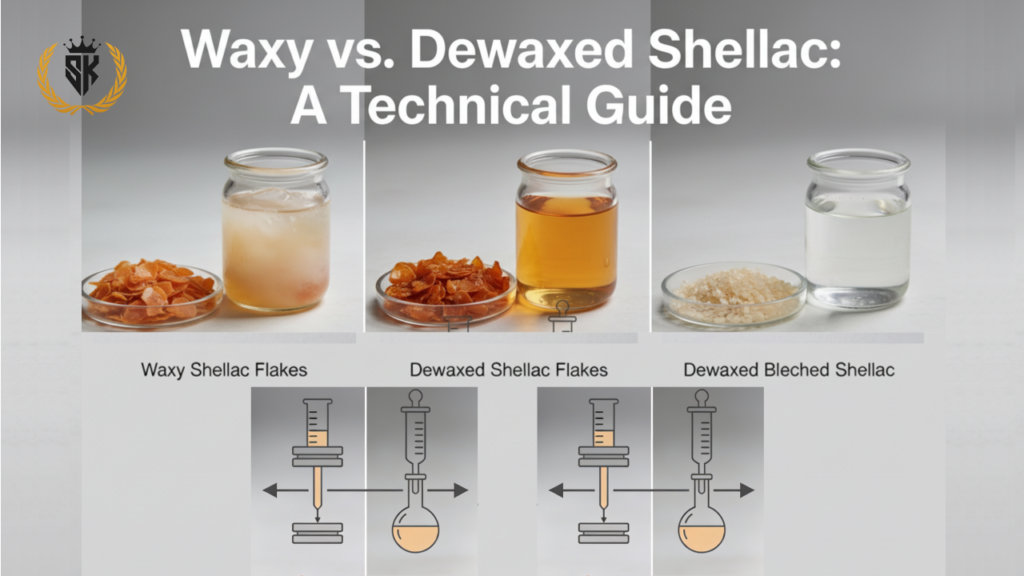
For industrial buyers, formulators, and professional end-users, choosing the right shellac isn’t just about picking a colour from a chart; it’s about understanding the underlying chemistry and how it affects performance. The single most critical technical distinction in the shellac world and the one that causes the most confusion and application failures is between standard “waxy” grades and refined “dewaxed” grades. This one factor profoundly influences the resin’s clarity, solubility, adhesion, compatibility with other materials, and overall performance in any given application. Understanding the difference between waxy and dewaxed shellac is essential for making the right purchasing decision.
The Nature of Shellac Wax
Natural shellac resin, as it is secreted by the insect and processed into seedlac, naturally contains approximately 3% to 5% wax. It’s important to understand that this wax is a separate chemical component from the resin itself, with different properties. The key properties of shellac wax that affect formulations are that it is a relatively hard,
natural wax with a high melting point. Most crucially for formulators, while shellac resin dissolves readily in alcohol (like ethanol or methanol), shellac wax is largely insoluble in cold alcohol.
Waxy Shellac: Characteristics and Uses
When standard seedlac, button lac, or regular flake shellac is dissolved in alcohol to make a solution (a “cut”), the resin goes into solution perfectly. However, the wax remains suspended as myriad tiny, insoluble particles. This gives the solution a characteristic cloudy, turbid, or milky appearance. When the finish is applied and dries, this wax becomes trapped within the resin film.
● Pros: The presence of wax can act as a lubricant, which is highly beneficial for the traditional process of French polishing. It also gives the final finish a slightly softer, more satiny, and warmer sheen compared to the high, brittle gloss of dewaxed shellac. Furthermore, due to fewer processing steps, waxy shellac is less expensive to produce.
● Cons: The wax reduces the film’s water resistance and causes a slight optical haze or lack of ultimate clarity. Most importantly, the wax is a release agent and is the primary cause of adhesion failures when trying to apply other types of finishes (like polyurethane, lacquer, or water-based topcoats) over a shellac base coat.
The Dewaxing Process
To create dewaxed shellac, this waxy solution must be subjected to a filtration process. This is an industrial shellac filtration process carried out in the factory. The shellac is dissolved in a solvent, sometimes heated to melt the wax, and then passed through a series of increasingly fine filter presses or centrifuges to physically remove the suspended wax particles and other
impurities. The solvent is then evaporated off to retrieve the pure, wax-free resin flakes.
Dewaxed Shellac: Characteristics and Uses
A solution made from dewaxed shellac flakes is crystal clear and transparent, with no turbidity. The basic characteristics of Dewaxed Shellac are:
- Superior Clarity: This is essential for applications like fruit coatings, clear wood finishes on fine grain, and cosmetic applications where the substrate’s true colour must shine through without any haze.
- Universal Compatibility: Without the interfering wax, the resin adheres tenaciously to almost anything and, crucially, allows almost any other type of finish to adhere tenaciously to it. This makes it the industry-standard “barrier coat” or universal sealer.
- Improved Water Resistance: The resulting film is harder, denser, and more durable against moisture ingress.
When to Use Dewaxed Shellac?
You should almost always specify dewaxed shellac for:
- Food glazing and fruit coating applications.
- Pharmaceutical coatings and binder applications.
- Sanding sealers in woodworking, especially under other finishes.
- Any application requiring high-gloss optical clarity.
- Any situation where the shellac will be top-coated with another material.
Conclusion:
At SK Shellac, we manufacture a full range of both waxy and dewaxed products to meet every technical requirement and budget. By understanding these fundamental differences, buyers can partner with us to select the exact grade that ensures optimal performance and avoids costly failures in their specific formulation.