
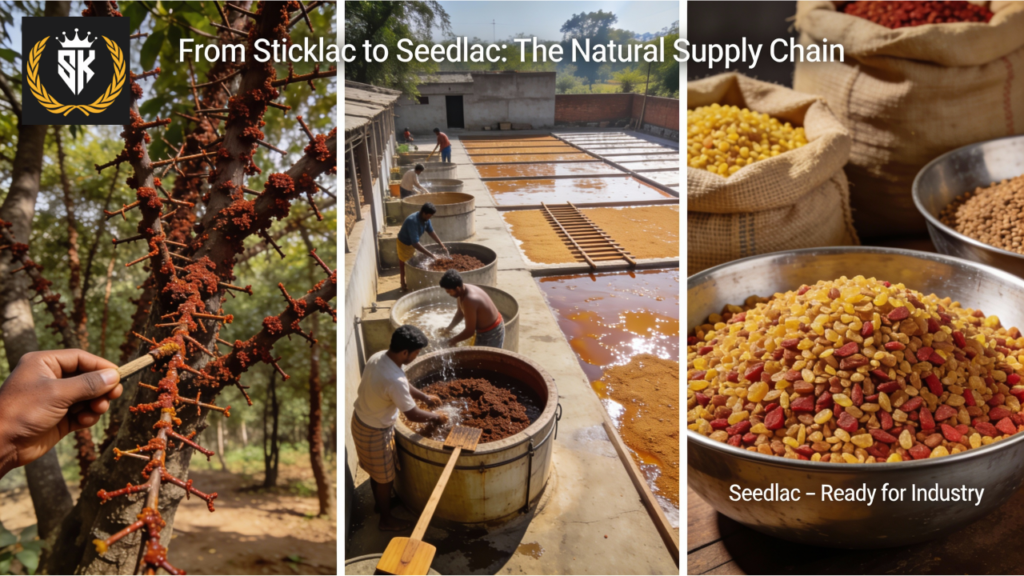
Every single finished shellac product, from the glistening glaze on a jelly bean to the French polish on a priceless antique table, starts its journey in the exact same place: on the branch of a tree in the forests of India or Thailand. Understanding this journey from the raw, natural source to the processed industrial material is crucial for appreciating the value of shellac as a sustainable resource and understanding the absolute importance of rigorous supply chain management and quality control. Let’s explore the transformation of raw sticklac into the foundational industry material known as seedlac.
The Source: Lac Cultivation
The story begins with a tiny, remarkable insect, Kerria lacca, the lac insect. Farmers in specific forest regions of India cultivate these insects on specific host trees like Palash, Kusum, and Ber. The tiny larval insects settle on the young, succulent twigs, insert their proboscises to feed on the tree’s sap, and secrete a protective resinous coating around their bodies to create
a tunnel-like tube. Over their life cycle, these countless insects secrete enough resin to encrust the entire twig, creating what is known as sticklac.
Harvesting involves carefully cutting these resin-encrusted twigs from the trees just before the new generation of insects swarms. This entire lac cultivation process provides a vital and sustainable source of supplementary income for millions of tribal families in rural India, making it an industry with deep socio-economic roots.
Processing Sticklac into Seedlac
Sticklac as harvested is a raw, impure material. It contains the valuable resin, but also woody twig parts, insect bodies, wax, and a water-soluble red dye known as lac dye. To become a useful industrial raw material, it must be processed through several steps.
- Crushing and Sieving: First, the sticklac is crushed in mills to separate the resin encrustation from the woody twig core. The larger woody material is then removed through a process of sieving and winnowing.
- Washing: This is the most critical step in determining quality. The crushed resin is washed repeatedly in large vats of water, often with the aid of friction. The primary goal is to dissolve and remove the red lac dye and the insect remains. The physical action of washing also helps to separate some of the natural wax from the resin.
- Drying: Once thoroughly washed and cleaned, the resin is spread out on large concrete floors to dry in the sun, a process that bleaches it slightly. The resulting product is seedlac, a small, grain-like particle of semi-refined lac resin. Its natural colour can range from a pale, valuable yellow to a deep reddish-brown depending on the host tree type and the thoroughness of the washing process.
The Importance of Quality Control
Seedlac is the essential raw material for manufacturing all other forms of shellac, including button lac, flakes, and bleached shellac. Therefore, the quality of the final product is directly and inescapably dependent on the quality of the initial seedlac. At SK Shellac, sourcing natural resins in India involves strict oversight at every stage. Quality control for shellac starts right here at the source. We rigorously test seedlac batches for crucial parameters before they enter our production lines:
- Flow & Life: These tests indicate the resin’s age, thermal properties, and polymerization state, critical for processing.
- Impurity Content: Ensuring that sand, wood, and insoluble matter are minimized to meet strict industry standards.
- Colour Index: To ensure colour consistency in the final manufactured products.
- Moisture Content: This is critical for ensuring long-term storage stability without blocking (clumping).
Conclusion:
Seedlac is the vital bridge between nature’s harvest in the forest and industrial application in the factory. By controlling quality at this foundational stage, SK Shellac ensures that our entire range of products is built on a base of purity, consistency, and reliability right from the start.