
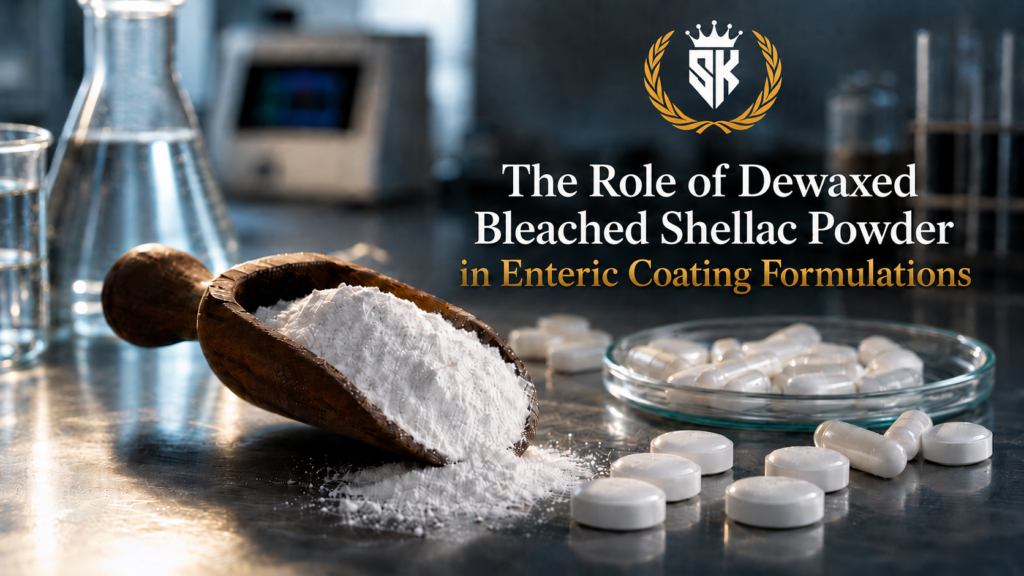
When pharmaceutical formulation teams design enteric-coated solid oral dosages, the primary challenge is always
timing. A successful enteric barrier must remain completely intact while traveling through the highly acidic gastric
environment of the stomach, and then dissolve predictably the moment it hits the neutral-to-alkaline pH of the
upper intestinal tract. For decades, synthetic polymers like methacrylic acid copolymers have been the industry
default. However, as global regulatory scrutiny increases and consumer preference shifts sharply toward clean-label
ingredients, high-purity dewaxed bleached shellac powder has emerged as a premium, reliable alternative.
The Technical Bottleneck: Why De-Waxing Matters
The core issue with standard, unrefined shellac has always been its natural wax content. Raw lac contains roughly
4% to 5% natural waxes. While these waxes are perfectly fine for heavy industrial coatings, they are a nightmare
for pharmaceutical chemists. Left unrefined, these embedded waxes reduce the clarity of the film, cause nozzle
clogging in high-speed fluid-bed sprayers, and dramatically slow down the dissolution profile. By utilizing highly
refined dewaxed bleached shellac powder, formulators eliminate these physical obstacles. The resulting film
coating is uniform, clear, and highly reproducible across large manufacturing batches.
The Chemistry of pH-Dependent Dissolution
From a chemical perspective, dewaxed bleached shellac is an excellent pH-dependent enteric excipient. In an
environment where the pH is less than pH = 5.5, the carboxyl groups within the shellac molecule remain un
ionized and tightly bound. This makes the coating completely insoluble in gastric juices, preventing stomach acids
from degrading acid-sensitive active pharmaceutical ingredients (APIs). However, as the tablet moves into the
duodenum, where the environment transitions to pH ≥ 6.8, the carboxyl networks undergo rapid ionization. The
coating dissolves smoothly, releasing the API precisely where it can be optimally absorbed by the body.
Ensuring Global Regulatory Compliance
1. Monograph Alignment (BP / USP / NF)
Working with a certified pharma-grade shellac supplier guarantees that the material meets the strict chemical
monographs set by the British Pharmacopoeia (BP), United States Pharmacopeia (USP), and National Formulary
(NF).
2. Supply Chain Resiliency
In an era where global logistics and raw material purity can make or break a production run, switching to a
premium, local natural tablet coating ensures that your final pharmaceutical products remain fully compliant,
highly stable, and perfectly optimized for consumer delivery.