
If you are a commercial procurement manager or a wood-finishing plant director, you already know that shellac is
one of the most versatile natural resins on the planet. But when you start looking into a bulk resin supply for
your facility, you will quickly find yourself choosing between two fundamentally different types of materials:
handmade shellac flakes and machine made shellac. While both originate from the exact same raw
material, their physical performance on a high-speed industrial line could not be more different.
The Structural Instability of Manual Thermal Stretching
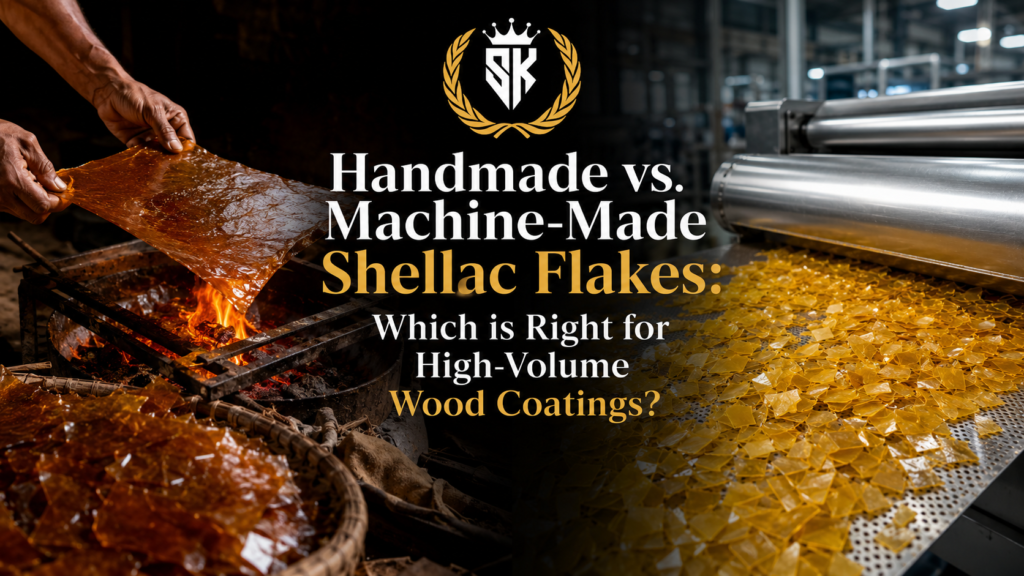
Handmade shellac is processed using traditional, century-old methods where operators manually stretch hot lacover charcoal fires. It is a fascinating process, and handmade flakes are highly valued by small-scale artisans and
traditional restorers who love its unique character. However, for industrial furniture polishing, handmade
material presents a massive challenge: a complete lack of batch standardization. Because it is processed manually
in open environments, handmade shellac can show noticeable variations in moisture retention, insoluble matter, and
exact wax levels from one batch to the next.
Preventing Nozzle Fouling and Orange-Peeling Defects
For automated industrial operations, those small variations can cause major technical issues. If your spray system iscalibrated for a specific viscosity, a sudden jump in moisture or wax content can result in uneven coatings, surface
orange-peeling, or completely clogged spray nozzles. This is why automated production lines rely exclusively on
machine-made shellac flakes. Processed using precision steam-heated autoclaves and automated cooling rollers,
machine-made flakes offer identical chemical specifications across every single container, giving you total peace of
mind during large manufacturing runs.
Operational Economics of Line Calibration
When choosing between these two paths, look closely at your application methods. If you are running an artisanalworkshop doing custom, low-volume hand applications, handmade options offer a great traditional touch. But if
you are managing a modern, high-throughput industrial finishing line where down-time costs thousands of dollars
per hour, standardized machine-made flakes are the only logical choice to keep your lines running smoothly,
predictably, and profitably.