
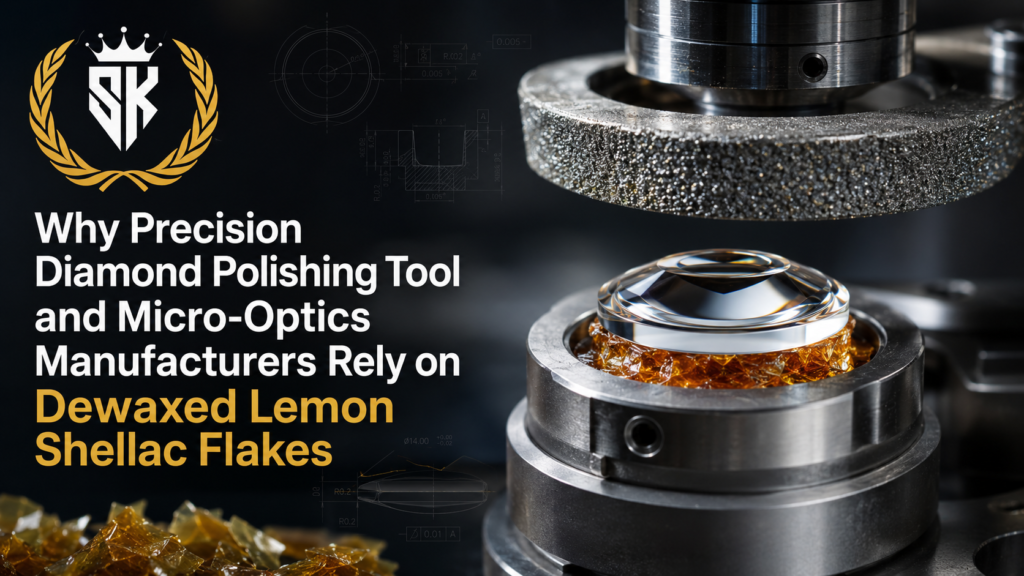
When engineering high-precision industrial tooling—like diamond polishing discs, gemstone grinding wheels, or
ultra-delicate micro-optics lenses—the biggest challenge isn’t the cutting material itself; it’s the adhesive matrix
holding everything in place. If your bonding agent shifts by even a single micron under high operational friction,
your entire workpiece is ruined. This is why leading precision tool manufacturers bypass standard synthetics and
rely on premium dewaxed lemon shellac as their core industrial shellac adhesive.
The Mechanical Paradox of Precision Component Mounting
The unique challenge in grinding gemstones and micro-optics is that the bonding agent must be incredibly rigidduring the abrasive process, yet easy to remove once the polishing is complete without damaging the delicate
substrate. Synthetic epoxies form permanent bonds. Stripping them requires harsh chemical solvents or intense heat, which can crack a diamond tool matrix or warp a precision glass lens. Dewaxed lemon shellac flakes solve
this problem by offering a perfect, predictable thermal release point.
Eliminating Matrix Deflection via Complete Wax Extraction
When heated, dewaxed lemon shellac melts into a highly uniform, low-viscosity liquid that blends perfectly withdiamond abrasive powders or can be used as a micro-optics polishing resin to mount lenses to polishing
blocks. As it cools, it hardens into a highly stable, inelastic solid that prevents any microscopic abrasive slippage
during high-speed polishing operations. Because the natural wax has been completely removed, the diamond
polishing tool binder maintains maximum structural density, ensuring there are zero soft pockets within the
adhesive matrix that could cause uneven tool wear.
Alcohol-Driven Solvent Stripping Workflows
Once the precision polishing cycle is done, separating the lens or diamond segment is incredibly simple. A modestapplication of heat or a quick rinse in industrial denatured alcohol cleanly releases the precision tool bonding
agent, leaving behind absolutely zero residue on the sensitive surface. Partnering with a specialized manufacturer
who can deliver uniform, premium-grade dewaxed lemon flakes allows advanced tool and optics lines to maintain
absolute tracking accuracy, clean operational workflows, and flawless surface finishes.