
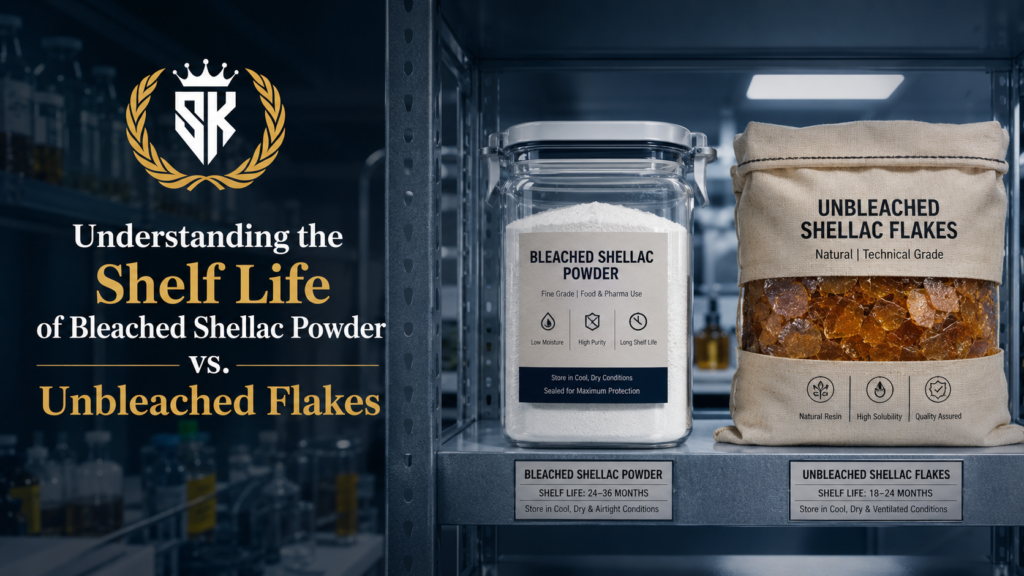
When chemical inventory managers plan bulk powder sourcing schedules, material stability is always a
primary concern. Natural shellac is an inherently reactive bio-polymer, meaning it doesn’t stay chemically inert
forever. To avoid unexpected raw material losses, it is vital to understand the major structural differences between
the bleached shellac powder shelf life and unbleached shellac flakes stability.
Thermal Extraction Consistency vs. Acid Precipitation Shifts
The core difference in shelf life comes down to how these two materials are chemically processed. Unbleachedshellac flakes—whether they are lemon, golden, or dewaxed varieties—are processed using thermal heat extraction.
This process leaves the natural resin structure highly compact and incredibly stable. Under proper **industrial
storage conditions** (cool, dry environments below 20°C), unbleached flakes can retain their chemical properties
and perfect alcohol solubility for several years without any noticeable degradation.
The Self-Polymerization Risk Matrix of Refined Powders
Bleached shellac powder, however, undergoes a completely different refinement process. To strip away its naturaldark color for clear applications, the resin is dissolved in an alkaline solution, chemically bleached using sodium
hypochlorite, and then re-precipitated with acid. This chemical alteration leaves the molecules in a much more
open, chemically reactive state. If bleached powder is exposed to ambient heat or humidity for extended periods, it
undergoes natural self-polymerization, turning into an insoluble material that will no longer dissolve in formulation
solvents.
Warehouse Management Protocols for Technical Resins
To maximize your inventory efficiency and prevent waste, managing your ordering cycles is key. Unbleachedflakes offer incredible long-term storage flexibility for high-volume industrial coatings. But for applications
requiring absolute transparency where bleached powder is necessary, procurement teams should prioritize ordering
fresh, factory-direct batches and storing them in climate-controlled warehouses. This simple step ensures your
materials perform perfectly on the production floor every single time.