
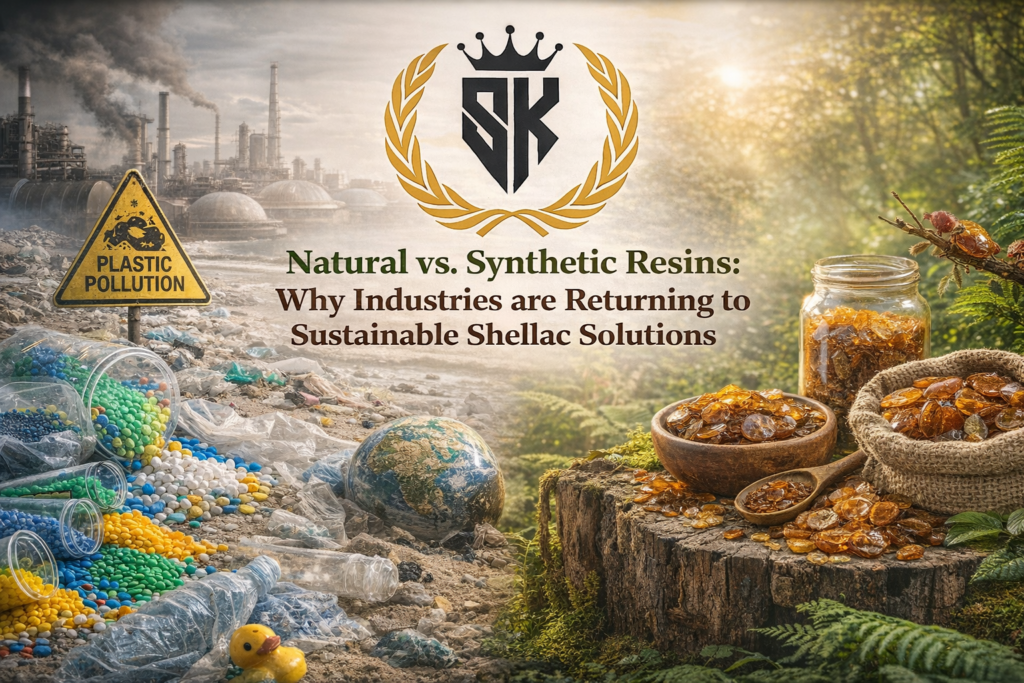
For the past century, the story of industrial materials and manufacturing has been dominated by the meteoric rise of synthetics. Petroleum-based plastics and resins promised unparalleled performance, consistency, versatility, and, perhaps most importantly, low cost. This pushed many traditional natural materials, which were perceived as inconsistent or old-fashioned, to the sidelines of manufacturing. But the tide is turning rapidly. As the world grapples with the undeniable global crises of plastic pollution, climate change, and resource depletion, industries are being forced by consumers and regulators to re-evaluate their material choices.
A powerful realization is dawning: sometimes, nature had it right the first time. This is driving a massive resurgence in interest in shellac, one of the world’s oldest, most versatile, and most effective sustainable coating materials.
The Synthetic Promise and its Hidden Cost
Synthetic resins, the acrylics, vinyls, epoxies, and polyurethanes used ubiquitously in everything from wood finishes and paints to food packaging and cosmetics are undeniably miracles of modern chemistry. But they come with a heavy, often hidden, environmental price tag embedded in their entire lifecycle:
- Finite Resource: They are almost exclusively derived from fossil fuels (oil and natural gas), a non-renewable and depleting resource whose extraction is increasingly expensive and damaging.
- Carbon Intensive: Their extraction, refining, and manufacture are highly energy-intensive processes that release significant amounts of greenhouse gases into the atmosphere, contributing to climate change.
- The Waste Crisis: Most synthetic resins are designed to be durable, which means they are not biodegradable. Once created, they persist in the environment essentially forever. They end up accumulating in landfills or, worse, polluting oceans and natural landscapes, where they break down into microplastics that contaminate our food chain and
- ecosystems.
Shellac: The Original Renewable Polymer
In stark contrast, shellac is a truly renewable resin source with a lifecycle perfectly aligned with nature’s cycles.
- Insect-Driven & Forest-Based: It is a resin secreted by the tiny lac insect, which feeds on tree sap. No trees are cut down to harvest them as the trees are hosts that are cared for year after year, promoting forest preservation.
- Low-Impact Processing: Converting raw lac into finished shellac is a physical process involving washing with water and heating. It requires far less energy, water, and fewer hazardous chemicals than synthesizing complex polymers from crude oil.
The Biodegradability Advantage
The most critical differentiator in today’s environmentally conscious market is end-of-life. Shellac is a natural, non-toxic biopolymer. It is fully biodegradable and compostable. A product coated with shellac can return to the earth and break down naturally without leaving a toxic legacy of microplastics or persistent chemicals. For companies seeking real, workable alternatives to synthetic polymers to meet aggressive corporate sustainability goals, this is a game-changer.
Performance Without Compromise
The best part for industry is that choosing “green” with shellac doesn’t mean sacrificing performance. For countless applications like food glazing, pharmaceutical coating, wood finishing, electrical insulation, and cosmetic binding, shellac’s natural properties, its unique film-forming ability, excellent adhesion, high gloss, and certified non-toxicity are often superior to the synthetics that tried to replace it.
Conclusion:
The future of industrial materials is not just about technical performance; it’s about responsibility and sustainability. By returning to eco-friendly industrial materials like shellac, companies are future-proofing their businesses, aligning with modern consumer values, and contributing to a healthier planet. SK Shellac is proud to be at the forefront of this sustainable revolution, supplying the high-quality natural resins that modern industry demands.