
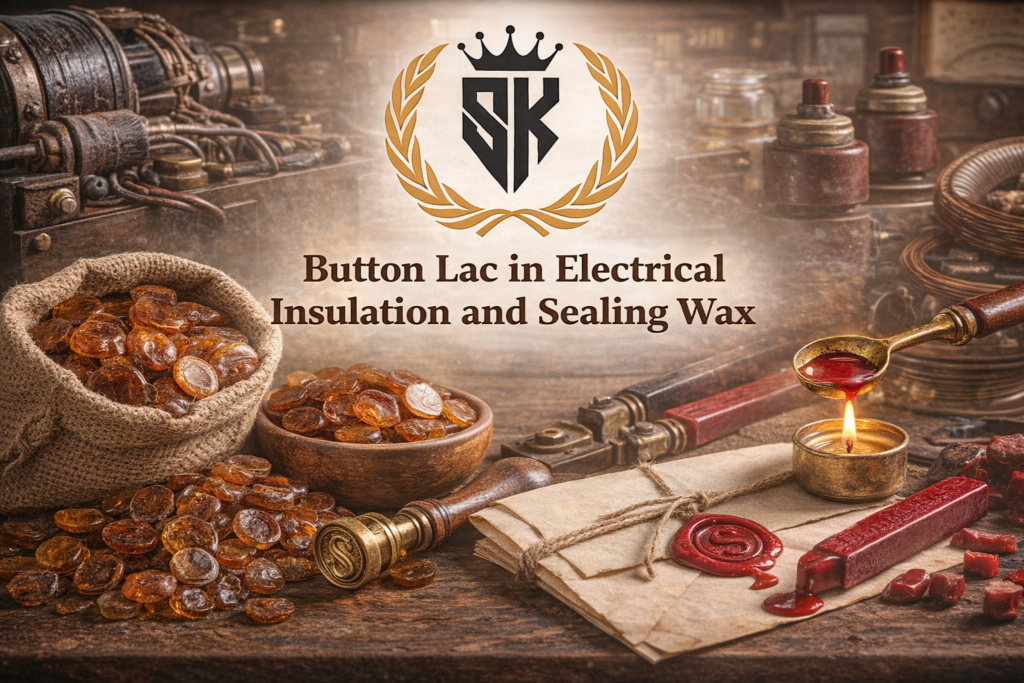
Introduction:
In our high-tech world dominated by silicon chips, fiber optics, and advanced synthetic polymers, it’s easy to forget the materials that laid the groundwork for the electrical age. Long before modern synthetic plastics like Bakelite or PVC became available, shellac was a premier industrial material, prized not just for its finish but for its remarkable functional properties.
Today, while synthetics dominate mass production, traditional forms of the resin, like button lac, continue to find critical uses in niche but vital applications, ranging from vintage electrical restoration to the manufacturing of premium sealing wax.
The Original Electrical Insulator
In the late 19th and early 20th centuries, the burgeoning electrical industry had a major problem – how to insulate wires, coils, and components effectively and reliably to prevent short circuits and ensure safety. Shellac proved to be the perfect answer. It possesses excellent dielectric strength, meaning it naturally resists the flow of electric current, and it is resistant to
tracking (the formation of conductive paths on its surface).
It was widely used to create shellac electrical varnish, which was used to impregnate the paper, cotton, or silk windings of motors, generators, transformers, and early electronic devices. The varnish would soak into the porous insulation material and dry to form a hard, solid, non-conductive mass that held the wires firmly in place, protected them from moisture and vibration, and provided crucial electrical insulation.
While synthetics have largely replaced it in mass production, the unique insulating properties of natural resins like shellac are still valued today in specific areas:
- Vintage Electronics Restoration: Restorers of antique radios, amplifiers, and electrical equipment use it to authentically recreate original insulating layers and finishes, ensuring historical accuracy and safe operation.
- High-Voltage Applications: Its specific properties regarding tracking resistance and arc resistance make it useful in certain specialized high-voltage insulator applications where some synthetics fail.
The Art of Sealing Wax
Another historic yet enduring application is in sealing wax manufacturing. Traditional sealing wax, used for centuries to seal letters, authenticate documents, and seal bottles, is a composite material, not just simple beeswax.
Button lac, with its natural wax content and robust, tough nature, acts as the primary binder and structural component in high-quality sealing waxes. It’s mixed with fillers (like chalk or gypsum) to give it body and pigments (like vermilion or modern substitutes for the classic red color). The shellac serves several critical functions:
- Adhesion: It ensures the molten wax sticks firmly to the paper or glass surface.
- Hardness but not Brittleness: The wax must dry hard enough to hold a sharp, detailed impression from a seal matrix but not be so brittle that it shatters easily in the mail or upon handling. Shellac’s unique thermoplastic properties are perfect for achieving this precise balance.
- Meltability: It allows the wax to melt smoothly over a flame without burning and sets quickly once applied.
Conclusion:
From insulating the coils of early electric motors to forming the wax seals on premium packaging today, the industrial uses of button lac are a testament to the enduring utility and unique properties of this remarkable natural material. SK Shellac is proud to supply high-quality button lac that meets the specific needs of these specialized industries, bridging the gap between historical craft and modern application.