
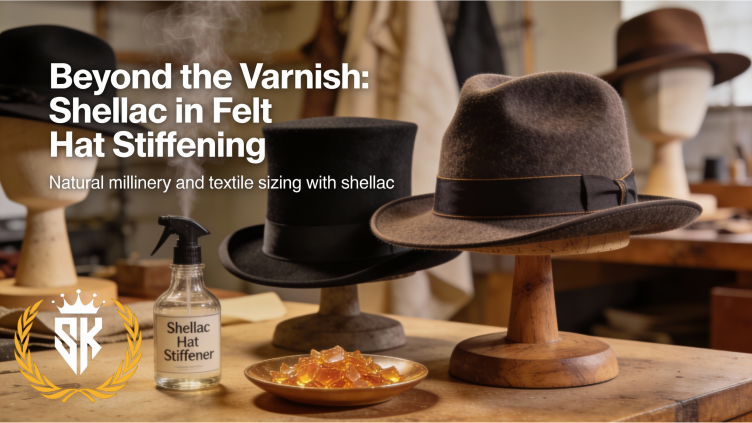
When you think of shellac, you probably think of shiny wood floors, French-polished antique furniture, or perhaps even the glossy coating on your favorite candies. You probably don’t think of the hat sitting on your head. Yet, for centuries, the millinery (hat-making) industry has been one of the most important, consistent, and demanding consumers of shellac. From a crisp, sharp fedora to a rigid, formal top hat, the structure, shape, and lasting durability of high-quality felt hats depend entirely on a hidden stiffening agent impregnating the fibers. Today, as artisans and consumers alike seek to move away from harsh chemicals, shellac is reclaiming its position as the premier natural hat stiffener.
The Science of Hat Blocking
A felt hat starts its life as a loose, floppy, cone-shaped “hood” made of wool or rabbit fur fibers felted together. To become a recognizable hat, it must be “blocked” – a process of being steamed to soften the fibers, stretched over a wooden hat block, and manipulated to take its final shape and size. But felt alone is soft and won’t hold that complex shape for long,
especially when exposed to rain, humidity, or wear. It needs a stiffener, or “sizing,” impregnated into the fiber matrix to lock them permanently in place once the hat dries.
Why Milliners Prefer Shellac
While various synthetic glues and PVA-based stiffeners are available today, traditional milliners and high-end hat makers continue to prize shellac for millinery for several distinct reasons related to performance and quality:
- Memory and Resilience: Shellac doesn’t just make the felt hard like a helmet; it gives it “memory.” A shellac-stiffened hat can be crushed or dented, but with a little steam to soften the resin, it can be coaxed back to snap perfectly into its original blocked shape. Synthetic stiffeners often make the felt brittle, causing it to break, crack, or crease permanently under stress.
- Water Resistance: Shellac is naturally resistant to water once it is dry and cured, helping the hat maintain its shape and stiffness even in damp or rainy weather, a crucial feature for outdoor wear.
- Breathability: Unlike some plastic-based stiffeners that coat the fibers entirely in a solid, impermeable layer, shellac stiffening tends to be more porous and breathable, making the final hat more comfortable to wear for long periods.
- Natural Origin: It is a non-toxic, sustainable, and historically authentic alternative to strong, solvent-based chemical stiffeners often used in industrial hat production, appealing to modern eco-conscious consumers and artisans.
The Process
Milliners typically make their own sizing by dissolving shellac flakes directly in alcohol (usually denatured alcohol) to create a liquid solution. The concentration of this solution determines the final stiffness of the hat. Often, a less-refined, orange or garnet grade is used for darker hats, while bleached shellac is used for white or light-colored hats to avoid staining. The felt hood is completely soaked in this solution, the excess is squeezed out, and then the hat is blocked and allowed to dry completely. As the alcohol evaporates, it leaves the hard resin behind to bond the fibers together internally.
Conclusion:
As a provider of traditional materials, SK Shellac is proud to support artisan crafts. Our shellac flakes are the perfect choice for milliners looking for effective, natural textile sizing agents and felt hat blocking materials that provide superior performance, durability, and honor the time-tested traditions of the trade.