
In boardrooms and R&D labs across the globe, one directive is becoming universal and inescapable: Sustainability. Industries ranging from packaging and food to cosmetics and paints are under immense pressure from consumers, regulators, and investors to reduce their environmental footprint and move away from finite, fossil-fuel-derived materials. In this urgent search for sustainable coating materials and binders, an ancient solution is proving to be remarkably modern and relevant. A life-cycle comparison reveals that natural shellac offers a profound environmental advantage over its synthetic counterparts.
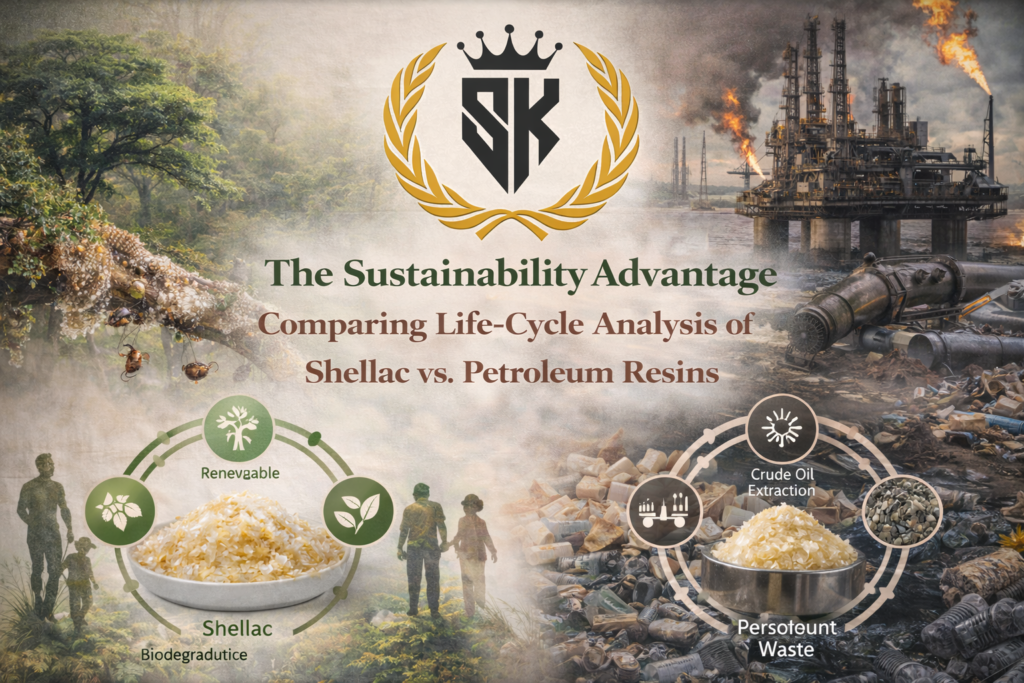
The Synthetic Lifecycle: A Linear Path from Crude Oil
Synthetic resins like the acrylics, polyurethanes, vinyls, and epoxies used ubiquitously in coatings, inks, and adhesives share a common origin story: they start their life as crude oil or natural gas pumped from the ground.
- Extraction & Refining: These initial processes are energy-intensive, ecologically damaging, and inherently polluting, releasing significant greenhouse gases and other pollutants.
- Manufacturing: Converting petrochemical feedstocks into complex monomers and then polymerizing them into resins requires significant energy input (often from fossil fuels) and often involves the use of hazardous chemicals, solvents, and catalysts.
- End of Life: This is the biggest and most intractable problem. Most synthetic resins are not biodegradable. Once created, they persist in the environment essentially forever. They end up accumulating in landfills or oceans, where they break down into harmful microplastics that pollute ecosystems and enter the food chain. It is a classic linear “take-make-dispose” model that is no longer sustainable on a finite planet.
The Shellac Lifecycle: A Circular Path from Nature
Shellac is a renewable resin source with a fundamentally different, circular life cycle aligned with nature’s processes.
- Sourcing: It starts with a bug and a tree. The lac insect feeds on tree sap and secretes resin to build its home. This is a continuous, renewable natural process that does not require cutting down the host trees. In fact, the economic value of lac cultivation encourages the preservation and planting of forest cover in India and Thailand, acting as a carbon sink and supporting biodiversity.
- Processing: Converting raw sticklac into finished shellac is a relatively low-energy physical process involving crushing, washing with water, and heating. No complex chemical synthesis, hazardous monomers, or toxic catalysts are required.
- End of Life: Shellac is a natural polymer, a bioplastic made by nature. It is fully biodegradable and compostable. At the end of a product’s life, a shellac coating will break down naturally through biological action and return to the ecosystem without leaving harmful microplastics or toxic residues behind. It fits perfectly into a circular economy model.
Social Sustainability
Beyond the environmental benefits, shellac also supports social sustainability. Lac cultivation is a vital source of supplementary income for millions of tribal and rural families in some of India’s poorest regions. Supporting the shellac industry is directly supporting these communities and their traditional way of life, preventing migration to urban slums.
Conclusion:
For companies actively seeking real alternatives to synthetic polymers and eco-friendly industrial materials, shellac is not a compromise on performance; it’s an upgrade in responsibility. It delivers high performance in coatings, adhesion, and barrier properties while offering an environmental profile that petroleum-based resins cannot hope to match. Choosing SK Shellac is a powerful statement of commitment to a sustainable future.