
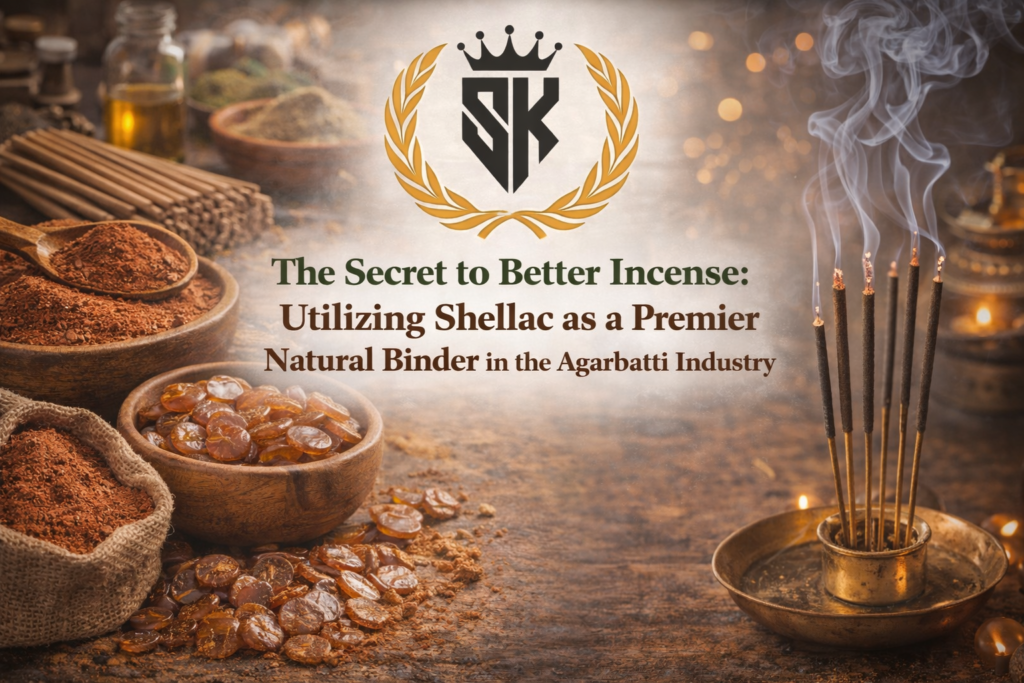
The Agarbatti (incense stick) industry is a massive and deeply rooted cornerstone of cultural,
spiritual, and daily life, especially in India. It is also a highly competitive and evolving sector
where product quality defines success and builds lasting brand loyalty. Manufacturers are
constantly seeking the perfect, consistent balance of ingredients to create a stick that is
physically strong, burns evenly and slowly, and delivers a pure, lasting, and pleasant
fragrance. While traditional binders like Jigat (powdered bark of the Machilus macrantha tree)
have been the industry standard for years, rising costs, supply inconsistencies, and increasing
scarcity are leading forward-thinking manufacturers to seek superior, sustainable alternatives.
This search points directly to one of nature’s most versatile resins: Shellac.
The use of shellac in the agarbatti industry is growing steadily as manufacturers realize its
unique ability to act not just as a simple glue, but as a multi-functional quality enhancer for
producing fine incense.
The Critical Role of the Binder
An incense stick is essentially a composite material – a mixture of aromatic powders, charcoal
dust, wood dust (sawdust), and perfume oils, held onto a bamboo core stick. The agarbatti
binding agent is the essential “glue” that holds this entire masala (paste) together and
adheres it to the stick.
A poor binder results in a host of production and quality problems:
● Brittle sticks that break easily during manufacturing, packaging, transport, or use by the
consumer.
● Uneven burning, sputtering, or sticks that keep going out mid-burn, frustrating users.
● An acrid, unpleasant burning smell from the binder itself that overpowers or clashes with
the intended added fragrance.
Why Shellac is the Ideal Natural Binder for Incense Sticks
Shellac is a natural, thermoplastic resin. Unlike many synthetic glues like PVA that can release
toxic or unpleasant chemical fumes when burned, shellac is a natural organic material that
burns cleanly. It offers several distinct advantages over both traditional Jigat and synthetic
binders:
- Superior Binding Strength and Flexibility
Shellac provides excellent adhesive qualities even at low concentrations. When mixed into the
masala dough, it ensures strong adhesion to the bamboo stick and excellent cohesion within
the paste itself. This results in smoother, more uniform sticks with higher mechanical strength
and flexibility, significantly reducing breakage and wastage during high-speed production and
packaging. - A Natural Fragrance Fixative
This is perhaps shellac’s most valuable hidden characteristic for incense. In the fine perfume
industry, shellac derivatives are widely used as fixatives—ingredients that anchor highly
volatile perfume oils and make the scent last longer on the skin. When used in agarbatti,
shellac acts as a natural fragrance fixative. It helps to encapsulate the expensive perfume oils
within the stick structure, preventing them from evaporating too quickly during storage before
the stick is even lit. When burnt, it ensures a slow, steady, and sustained release of the aroma,
making the incense experience richer and longer-lasting for the user. - Clean Burning and Improved Burn Time
A premium agarbatti must burn slowly, continuously, and evenly without generating harsh or
excessive smoke. Shellac, being a natural organic resin, burns cleanly with a pleasant, very
faint, sweet aroma that does not clash with the added perfumes. Furthermore, its presence
helps regulate the combustion process of the charcoal and wood dust, contributing to
improving agarbatti burning time by ensuring a slow, even smolder rather than a fast, hot
burn. - A Cost-Effective and Consistent Jigat Alternative
The traditional binder, Jigat, is a forest product that is becoming increasingly expensive and
difficult to source consistently due to environmental pressures. Shellac serves as an excellent,
sustainable, and readily available Jigat alternative or supplement. By replacing a portion of
expensive Jigat with high-quality shellac powder, manufacturers can maintain or even improve
stick quality while managing raw material costs effectively and ensuring supply chain stability.
How Shellac is Used in Formulation
For the agarbatti industry, shellac is typically used in fine powder form (ground seedlac or
flakes are ideal). This powder is dry-mixed thoroughly with the other masala ingredients
(charcoal, wood powder, Jigat, etc.) before water is added to form the dough. The exact
amount used varies depending on the other ingredients and the desired stick hardness and
burn rate, but even small percentages can yield significant improvements.
Conclusion:
In the fiercely competitive world of incense manufacturing, moving beyond basic, inconsistent
binders to functional, high-quality ingredients is key to premiumization and brand
differentiation. SK Shellac supplies consistent, high-quality natural shellac that serves as the
perfect multi-functional binding solution for modern agarbatti manufacturers. By integrating
our natural resin, you ensure your incense sticks are strong, burn beautifully, and deliver an
unforgettable, long-lasting fragrance experience that keeps customers coming back.